
A Hidden Cost Analysis for Shisha Lounges and Commercial BBQ Businesses
In the shisha lounge and commercial BBQ industry, charcoal is not just a supporting element—it is a core factor that directly affects operational efficiency, cost control, and customer experience. While low-quality briquettes or charcoal may appear cost-effective at first, they often create hidden costs that reduce overall profitability over time.
Many businesses focus only on the price per kilogram, assuming cheaper charcoal offers better value. In reality, performance is what determines true cost. Low-quality briquettes tend to burn faster, produce unstable heat, and deliver inconsistent results—leading to higher consumption and inefficiency in daily operations.
The Real Cost Behind Low-Quality Charcoal
At first glance, most briquettes or charcoal products may look similar—solid, uniform, and ready to use. However, appearance alone does not reflect performance. Low-grade charcoal typically burns too quickly, struggles to maintain stable heat, and produces excessive ash and smoke.
In professional environments such as shisha lounges or BBQ restaurants, these issues create continuous operational disruptions. Faster burn rates mean more frequent replacement, increasing fuel consumption per session. Over time, this directly raises operational costs and reduces overall efficiency—especially in high-volume settings.
Beyond burn duration, production quality also plays a major role. Even when using the same raw material, differences in carbonization, density, moisture control, and manufacturing consistency can significantly impact performance. High-quality briquettes are engineered to maintain stable heat and longer burning time, while low-quality products often fail to deliver consistent results.
Inconsistency Leads to Inefficiency
Another critical issue with low-quality briquettes or charcoal is inconsistency in shape and structure. Irregular sizes and weak composition lead to uneven heat distribution, making temperature control difficult.
In daily operations, this translates into wasted product, slower service, and unpredictable performance. For businesses that rely on consistency—especially premium shisha lounges—this directly affects customer satisfaction and brand perception.
High ash content and excessive smoke further compound the problem. Poor carbonization and inconsistent raw materials often result in charcoal that leaves heavy residue and disrupts airflow. This not only reduces heat efficiency but also negatively impacts the customer experience, particularly in environments where clean burn and smooth sessions are expected.
Why High-Quality Briquettes Deliver Better Value
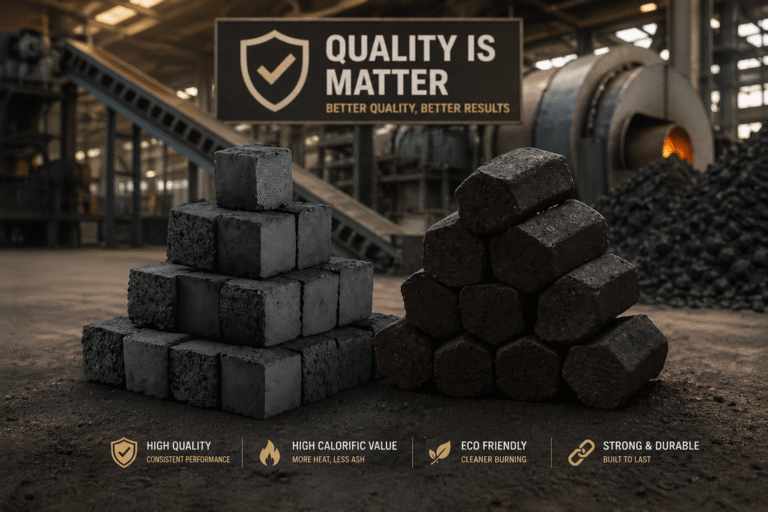
In contrast, high-quality briquettes or charcoal are designed with performance and reliability in mind. They provide stable heat output, longer burning duration, and low ash residue—ensuring efficient and consistent use across every session.
Clean combustion with minimal smoke enhances the overall experience, while strong density and structural integrity ensure the product performs reliably from start to finish. For distributors and importers, consistency across batches is equally important, as it guarantees predictable performance for end users.
Conclusion: Cheap Charcoal Is a Costly Decision
While low-cost briquettes or charcoal may seem like a smart short-term choice, the long-term impact tells a different story. Faster consumption, unstable performance, and operational inefficiencies ultimately lead to higher costs and reduced customer satisfaction.
For professional use, charcoal should not be evaluated by price alone. Performance, consistency, and reliability are what truly define value. Choosing high-quality briquettes or charcoal is not just a purchasing decision—it is a strategic investment in efficiency, service quality, and long-term profitability.