
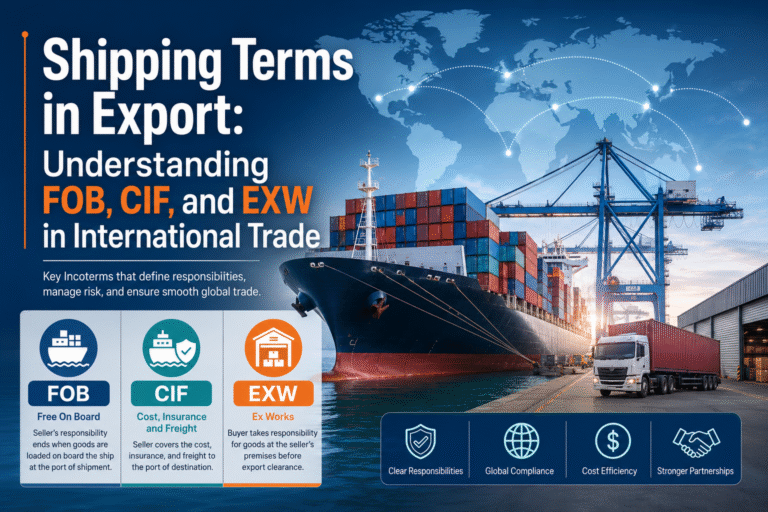
In global trade, understanding shipping terms in export is essential for both exporters and importers. Terms like FOB, CIF, and EXW are widely used in international transactions to define responsibility, cost distribution, and risk transfer during the shipment process.
Without a clear understanding of these Incoterms, businesses may face unexpected costs, delays, or miscommunication. That is why choosing the right shipping term is critical for efficient and secure export operations.
What Are Incoterms in Export and Import?
Incoterms (International Commercial Terms) are globally recognized standards published by the International Chamber of Commerce. These terms clearly define the roles between sellers and buyers in international shipping.
They regulate key aspects such as:
- Delivery point of goods
- Transfer of risk
- Responsibility for shipping and logistics costs
- Export and import customs clearance
Using the correct Incoterm ensures transparency and reduces disputes in international trade.
EXW (Ex Works): Full Control for the Buyer
EXW (Ex Works) is one of the most basic and commonly used shipping terms in export.
Under EXW, the seller’s responsibility is limited to preparing the goods and making them available at their warehouse or factory. From that point onward, the buyer takes full control of the shipment process, including pickup, export clearance, international freight, insurance, and final delivery.
This means the risk transfers to the buyer at the seller’s location.
EXW is suitable for experienced importers who have strong logistics networks. However, for new buyers, it can be complex due to the high level of responsibility involved.
FOB (Free On Board): The Most Popular Export Shipping Term
FOB (Free On Board) is one of the most widely used shipping terms in international trade.
Under FOB, the seller is responsible for handling the goods until they are loaded onto the vessel at the port of origin. This includes packaging, export documentation, customs clearance, and loading.
Once the goods are on board, the risk transfers to the buyer, who then handles ocean freight, insurance, and import processes.
FOB is preferred because it offers a balanced distribution of responsibility and provides clarity for both parties, making it ideal for most export transactions.
CIF (Cost, Insurance, and Freight): Simplified Shipping for Buyers
CIF (Cost, Insurance, and Freight) is a shipping term that provides more convenience for buyers.
Under CIF, the seller covers not only the export process and loading (as in FOB), but also the cost of ocean freight and basic insurance during transit. This reduces the logistical burden on the buyer.
However, it is important to note that risk still transfers to the buyer once the goods are loaded onto the vessel, even though the seller pays for shipping.
CIF is often chosen by buyers who prefer a more streamlined and hassle-free shipping arrangement.
Key Differences Between FOB, CIF, and EXW
The main difference between these shipping terms lies in who controls cost and risk at each stage of the export process.
- EXW (Ex Works): Buyer handles all logistics from the seller’s location
- FOB (Free On Board): Seller handles until goods are loaded onto the vessel
- CIF (Cost, Insurance, Freight): Seller pays for shipping and insurance, but risk transfers at loading
Understanding these differences helps businesses choose the most efficient and cost-effective shipping method.
How to Choose the Right Shipping Term
Selecting the right shipping term depends on your business strategy and logistics capability.
If you want full control over shipping, EXW may be suitable. If you prefer a balanced approach, FOB is often the best option. For buyers who prioritize convenience, CIF offers a more simplified process.
In most cases, FOB is considered the standard choice because it provides clarity, flexibility, and shared responsibility between both parties.
Conclusion
Understanding FOB, CIF, and EXW shipping terms is crucial for successful international trade. These terms determine not only costs, but also risk allocation and operational control throughout the supply chain.
By choosing the right Incoterm, businesses can improve efficiency, minimize risk, and ensure smooth export-import transactions in a competitive global market.
Work With a Trusted Export Partner
At PT Tuan Energi Indonesia, we support global buyers with flexible shipping terms including EXW, FOB, and CIF, ensuring every export process is clear, efficient, and aligned with your business needs.
With professional export handling and consistent product quality, we are ready to help you navigate international trade with confidence.