
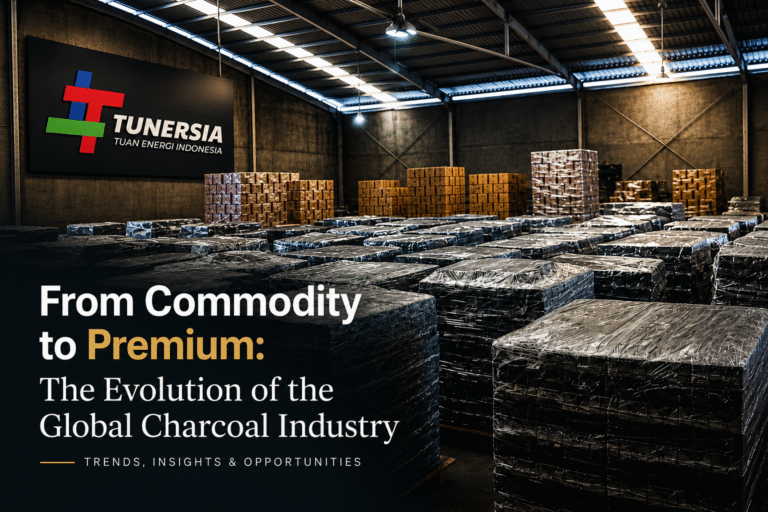
The global charcoal industry is undergoing a significant transformation. What was once considered a low-value commodity is now evolving into a performance-driven, premium product category.
Across international markets—especially in Europe and the Middle East—buyers are no longer focused solely on price. Instead, they are prioritizing quality, consistency, and long-term reliability when selecting charcoal suppliers.
This shift marks a new era in the global charcoal market, where value is defined not by cost, but by performance.
The Traditional Charcoal Market: Price-Driven and Inconsistent
Historically, charcoal was treated as a basic fuel product. Buyers made decisions primarily based on price, with little attention to quality standards or production processes.
This approach often led to:
Inconsistent burning performance
High ash production
Unstable heat output
Variability between shipments
While these issues were tolerated in the past, modern markets no longer accept such inconsistencies—especially in professional and commercial applications.
The Shift Toward Premium Charcoal
Today, the charcoal industry is shifting toward a premium, performance-based market.
Driven by industries such as hospitality, shisha lounges, and professional BBQ operations, demand is increasing for charcoal that delivers:
Longer burning duration
Stable and controlled heat
Low ash production
Clean combustion without odor
This shift reflects a broader trend in global trade: buyers are willing to pay more for predictable performance and operational efficiency.
What Defines Premium Charcoal Today
In the modern market, premium charcoal is defined by consistency and measurable performance.
High-quality charcoal products are expected to have:
Uniform shape and density
Reliable burning duration
Consistent heat output
Low ash and minimal smoke
These characteristics are not achieved by chance—they are the result of controlled production processes and strict quality control systems.
For global buyers, this consistency reduces risk and improves efficiency, making premium charcoal a strategic choice rather than a cost.
The Role of Production and Quality Control
One of the key drivers behind the evolution of the charcoal industry is the advancement in production technology and process control.
Modern manufacturers focus on:
Standardized raw material selection
Controlled carbonization and mixing processes
Consistent pressing and drying methods
Ongoing quality testing and verification
These improvements ensure that charcoal products meet export-grade standards and deliver consistent performance across every shipment.
From Supplier to Strategic Partner
As the market evolves, the role of charcoal exporters is also changing.
Buyers are no longer looking for simple suppliers—they are seeking reliable partners who can:
Maintain consistent quality over time
Provide transparency in production and testing
Support long-term business growth
This shift transforms the relationship from transactional to strategic, where trust and reliability become the foundation of success.
Why This Evolution Matters for Global Buyers
For importers and distributors, the transition from commodity to premium charcoal offers significant advantages.
By choosing high-quality charcoal, businesses can:
Reduce consumption and operational costs
Improve customer experience
Maintain consistent performance across operations
Strengthen their brand reputation
In competitive markets, these benefits create a clear advantage.
The Future of the Charcoal Industry
The future of the charcoal and briquette market will continue to be shaped by quality, sustainability, and consistency.
As global demand grows, expectations will rise even further. Suppliers who invest in process control, quality assurance, and long-term partnerships will lead the industry.
The era of price-only competition is coming to an end—replaced by a market where performance defines value.
Conclusion
The evolution of the charcoal industry from commodity to premium is not just a trend—it is a fundamental shift in how the market operates.
Businesses that embrace this transformation by focusing on consistency, quality, and reliability will not only compete—but lead in the global market.