
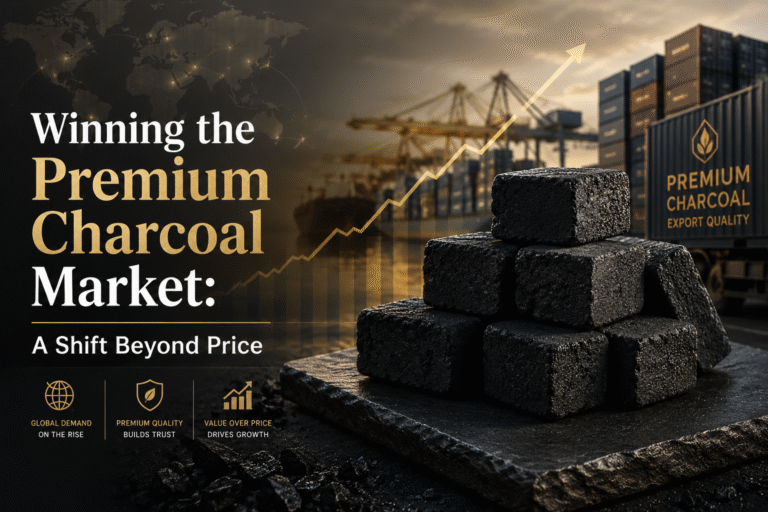
The global charcoal and briquette market is evolving rapidly. Price is no longer the only factor influencing purchasing decisions—today’s buyers are increasingly focused on performance, consistency, and long-term reliability.
Across international markets, particularly in Europe, expectations have shifted significantly. Importers, distributors, and end-users are no longer satisfied with products that simply meet basic requirements. Instead, they are seeking high-quality charcoal and briquettes that deliver predictable results, stable heat, and consistent performance across every use.
For producers and exporters, this transformation creates a clear opportunity to move away from price-based competition and position themselves in the premium charcoal segment, where value is defined by quality and trust.
The Growing Demand for High-Performance Charcoal
As industries such as hospitality, food service, and lifestyle experiences continue to expand, charcoal has become more than just a fuel source. It now plays a direct role in the overall customer experience.
Buyers are increasingly prioritizing charcoal products that burn longer, produce stable heat, generate minimal ash and smoke, and maintain consistent performance over time. These characteristics are essential for improving operational efficiency, reducing fuel consumption, and ensuring a reliable end-user experience.
In this context, performance is no longer an added benefit—it is a fundamental requirement.
What Defines Premium Charcoal Quality
In today’s market, the quality of charcoal and briquettes is determined not by appearance, but by real-world performance.
High-quality charcoal is typically defined by its ability to deliver long burning duration, clean combustion without unwanted odor, uniform shape and density, and consistent results across batches and shipments. These factors directly influence efficiency, cost control, and customer satisfaction.
When these standards are not achieved, businesses often experience higher consumption rates, inconsistent heat output, and operational inefficiencies—ultimately increasing costs over time.
Bridging the Gap Between Claims and Performance
One of the most significant challenges in the global charcoal industry is the gap between claimed product quality and actual performance.
Although many suppliers position their products as “premium charcoal,” inconsistencies in production, unstable burning behavior, and lack of proper quality control remain common issues. For buyers, this creates uncertainty and increases risk, especially when consistency is critical to their operations.
As a result, reliability has become a key factor in supplier selection, making proven performance and quality assurance more valuable than marketing claims alone.
The Role of Standards and Compliance
As the global market becomes more competitive, compliance with product standards and quality assurance processes is increasingly important.
Buyers are paying closer attention to product safety, consistency in production, and transparency in testing and specifications. Exporters who can demonstrate clear standards and controlled processes are better positioned to build credibility and long-term partnerships.
In many cases, compliance is no longer just a requirement—it is part of the product’s overall value.
From Commodity Supplier to Strategic Partner
The charcoal and briquette industry is shifting from transactional supply toward long-term, relationship-driven partnerships.
Modern buyers are not only sourcing products—they are choosing partners who can deliver consistent quality, maintain reliable supply chains, and support sustainable business growth. This shift marks a transition from being a simple supplier to becoming a trusted partner in the supply chain.
Conclusion
The future of the global charcoal and briquette market is defined by performance, consistency, and trust.
Businesses that can deliver high-quality charcoal, maintain stable production standards, and build long-term relationships will be in the strongest position to succeed. In a market where expectations continue to rise, reliability is no longer optional—it is the foundation of competitiveness.