
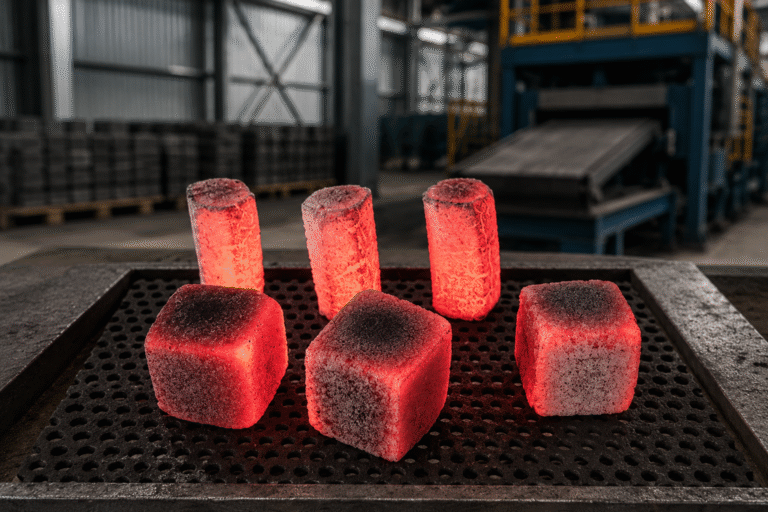
In the global charcoal and briquette industry, product quality is defined not only by appearance but by measurable technical parameters. Among the most important are ash content, moisture content, and fixed carbon—three key indicators that directly influence charcoal performance, efficiency, and consistency.
For importers, distributors, and professional users, understanding these parameters is essential when selecting a reliable charcoal supplier.
Why Technical Parameters Matter in Charcoal Quality
In modern markets, especially for export-grade charcoal, buyers no longer rely on visual inspection alone. Instead, they evaluate charcoal based on performance metrics that determine:
Heat output and burning duration
Clean combustion and smoke level
Efficiency and consumption rate
Among these, ash content, moisture, and fixed carbon play a central role in defining overall quality.
Ash Content: Indicator of Residue and Efficiency
Ash content in charcoal refers to the amount of non-combustible residue left after burning.
Lower ash content indicates:
Cleaner combustion
Better airflow during use
Higher efficiency and less cleaning effort
High ash content, on the other hand, can:
Block airflow
Reduce heat efficiency
Increase maintenance during operation
For premium applications such as shisha charcoal and professional BBQ, low ash content is a critical requirement.
Moisture Content: Impact on Ignition and Stability
Moisture content in charcoal measures the amount of water present in the product.
Proper moisture levels are essential for:
Easy ignition
Stable and consistent burning
Reduced smoke during use
If moisture content is too high, charcoal may:
Be difficult to ignite
Produce excessive smoke
Burn unevenly
Well-controlled production ensures that moisture levels remain within optimal ranges for consistent performance.
Fixed Carbon: The Source of Heat and Energy
Fixed carbon in charcoal represents the amount of carbon available for combustion after removing moisture and volatile substances.
Higher fixed carbon content results in:
Stronger and more stable heat output
Longer burning duration
More efficient energy release
Low fixed carbon levels can lead to weaker heat performance and shorter burn time, making it unsuitable for professional applications.
The Relationship Between Ash, Moisture, and Fixed Carbon
These three parameters are closely interconnected and must be balanced for optimal performance.
High-quality charcoal typically has:
Low ash content
Controlled moisture level
High fixed carbon content
This combination ensures clean combustion, stable heat, and consistent performance, which are essential for both commercial and export markets.
Why These Parameters Matter for Global Buyers
For international buyers, these technical specifications are more than just numbers—they represent reliability.
Charcoal that meets proper standards in ash, moisture, and fixed carbon offers:
Predictable performance across shipments
Improved operational efficiency
Lower long-term costs due to reduced consumption
This is why professional buyers increasingly demand lab-tested and specification-based charcoal products.
Conclusion
Understanding ash content, moisture content, and fixed carbon in charcoal is essential for evaluating product quality and performance.
These parameters define how charcoal burns, how long it lasts, and how efficiently it performs. For businesses that rely on consistent results, choosing charcoal with the right balance of these factors is critical.